

Mongolia's Environment-Economy Nexus: Balancing Resource-Driven Growth with Ecological Sustainability
Enkh-Amgalan Oyumaa
Independent Researcher, Ulaanbaatar, Mongolia
Abstract: Mongolia's economy is heavily dependent on natural resource extraction and traditional livestock herding, a dual structure that has generated rapid GDP growth but also severe environmental degradation. This paper analyzes the complex interactions between Mongolia's economic development model and its environmental outcomes, focusing on three critical domains: mining sector environmental impacts, pastoral overgrazing and grassland degradation, and urban air pollution in Ulaanbaatar. Drawing on recent economic and environmental data (2023–2025), the study evaluates the effectiveness of existing policy frameworks—including Vision 2050, Mongolia's Nationally Determined Contributions under the Paris Agreement, and the Green Growth Policy—and identifies persistent implementation gaps. The paper proposes an integrated strategy for transitioning toward a green economy that addresses energy diversification, environmental governance in mining, sustainable livestock management, urban pollution reduction, and climate resilience. The analysis concludes that Mongolia stands at a critical juncture where economic development and environmental sustainability must be pursued as complementary objectives, and that failure to act decisively risks locking in long-term environmental degradation that will undermine economic competitiveness, public health, and social stability.
Keywords: Mongolia, environment-economy nexus, green economy, mining, overgrazing, air pollution, climate change, sustainable development
1. Introduction
Mongolia's economic trajectory presents a paradox common to resource-rich developing countries: the very resources that drive economic growth simultaneously generate environmental costs that threaten long-term prosperity. The mining sector, which accounts for approximately 25% of GDP and over 90% of total exports, has been the primary engine of economic growth in the 21st century, anchored by world-class deposits such as the Oyu Tolgoi copper-gold mine and the Tavan Tolgoi coal deposit. Simultaneously, the livestock sector employs approximately 30% of the workforce and remains the economic and cultural foundation of rural Mongolia (National Statistics Office, 2025).
However, this resource-intensive economic structure has produced mounting environmental pressures. Mining operations have caused significant groundwater depletion, soil contamination, and dust pollution, particularly in the South Gobi region. Livestock numbers have surged from approximately 20 million in 1990 to over 60 million by 2024, far exceeding the theoretical carrying capacity of Mongolia's grasslands and driving widespread pastureland degradation. In Ulaanbaatar, where nearly 50% of the national population resides, winter air pollution from coal-burning in ger districts routinely exceeds World Health Organization safety guidelines by 20–30 times (Ministry of Environment and Tourism, 2024).
This paper examines the environment-economy nexus in Mongolia through a systematic analysis of three critical domains: mining, pastoralism, and urbanization. It evaluates existing policy responses, identifies implementation gaps, and proposes strategic pathways toward a sustainable green economy that balances growth with ecological preservation.
2. Mining Sector: Economic Engine and Environmental Challenge
The mining sector's dominance in Mongolia's economy creates both opportunities and vulnerabilities. The Oyu Tolgoi mine, reaching full-scale underground production in 2025–2026, is projected to contribute significantly to GDP growth and government revenue for decades. However, the environmental costs of mining are substantial and growing. Water depletion is perhaps the most critical concern: copper processing is highly water-intensive, and mining operations in the South Gobi have caused severe groundwater level declines, creating intensifying conflicts with herding communities that depend on the same water resources for their livestock and livelihoods.
Coal mining presents additional environmental challenges. Open-pit coal mines generate massive quantities of dust, contributing to localized air pollution and soil degradation. More broadly, coal dominates Mongolia's energy mix, accounting for over 90% of domestic energy and heating consumption and making the country one of the most carbon-intensive economies in the world relative to GDP. This carbon intensity creates both environmental damage and economic risk, as global carbon pricing mechanisms and trade partner climate policies increasingly penalize carbon-heavy exports.
Environmental governance in the mining sector remains inadequate despite strengthening regulatory frameworks. Environmental impact assessments are frequently conducted retrospectively rather than preventively, enforcement of environmental standards is inconsistent, and mine closure and rehabilitation requirements are poorly funded and rarely enforced. The result is a growing legacy of unreclaimed mine sites that impose long-term environmental and social costs.
3. Pastoral Sector: Overgrazing and Grassland Degradation
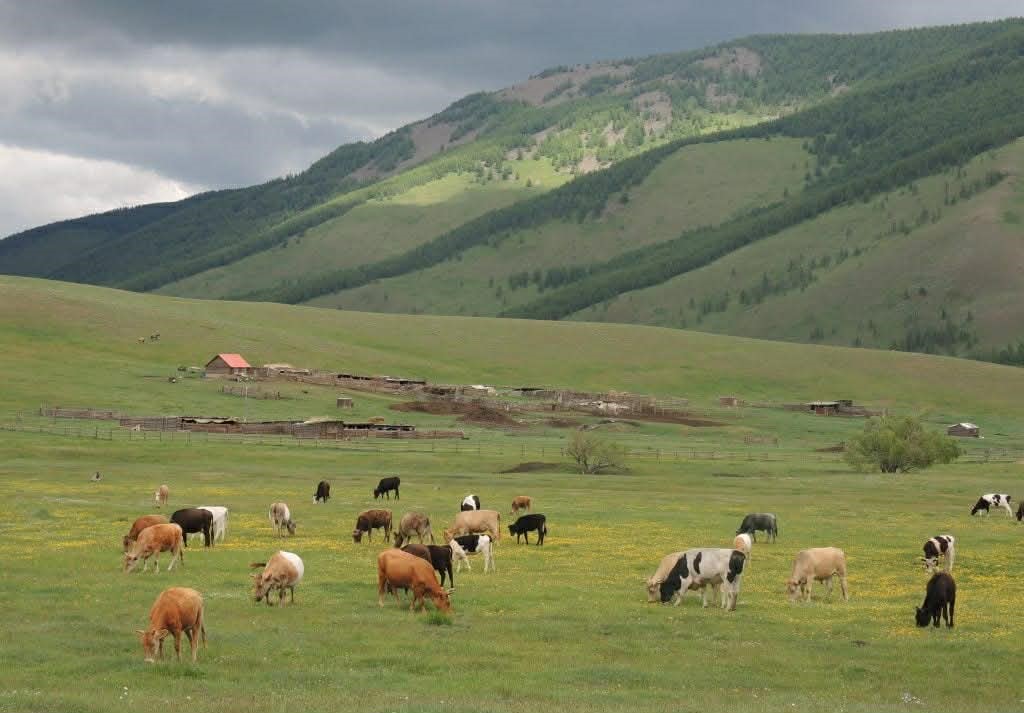
The dramatic increase in livestock numbers following Mongolia's transition to a market economy has created what many environmental scientists describe as an ecological crisis. Over 76% of Mongolia's territory now shows some degree of desertification, with the most severe degradation concentrated around urban centers, water sources, and major transport corridors where livestock tend to concentrate. The carrying capacity of Mongolia's grasslands is estimated at approximately 30–35 million head of livestock—roughly half the current national herd (Ministry of Environment and Tourism, 2024).
Climate change has compounded the overgrazing problem. Mongolia's average temperature has increased by approximately 2.25°C since 1940—more than double the global average—leading to reduced precipitation in some regions, altered growing seasons, and increased frequency of extreme weather events. The devastating 2024–2025 dzud (severe winter), which killed millions of livestock, starkly demonstrated the vulnerability of overstocked herds on degraded grasslands to climate shocks.
The economic consequences of grassland degradation are severe but often undervalued in national economic accounting. Reduced pasture productivity directly translates to lower livestock productivity, increased animal mortality, and declining quality of animal products including cashmere, wool, and meat. Degraded grasslands also provide reduced ecosystem services including carbon sequestration, water filtration, and biodiversity habitat—losses that have significant but poorly quantified economic value.
4. Urban Air Pollution: The Ulaanbaatar Crisis
Ulaanbaatar's air pollution crisis is one of the most severe in the world and represents the most immediate health-related environmental challenge facing Mongolia. During winter months (October through April), residents of the city's extensive ger districts burn raw coal, wood, and other fuels for heating in traditional stoves. The resulting particulate matter (PM2.5) concentrations frequently exceed WHO safety guidelines by 20–30 times, creating a public health emergency that disproportionately affects children, the elderly, and low-income households.
The health costs of Ulaanbaatar's air pollution are estimated at 2–4% of national GDP, encompassing increased healthcare expenditures, lost productivity, premature mortality, and chronic disease burden. Research has documented elevated rates of respiratory illness, cardiovascular disease, and adverse pregnancy outcomes in Ulaanbaatar's most polluted districts. The economic costs extend beyond health: air pollution reduces the city's attractiveness for international investment, tourism, and skilled labor retention.
Government responses have included subsidized distribution of improved heating stoves, restrictions on raw coal sales, and plans for expanded central heating networks and energy-efficient housing. However, implementation has been slow and uneven, hampered by funding constraints, resistance from affected households, and the fundamental challenge of providing affordable heating alternatives in one of the world's coldest capital cities.
5. Policy Framework Analysis and Implementation Gaps
Mongolia has adopted several ambitious policy frameworks addressing environmental sustainability. Vision 2050, the country's long-term development strategy, explicitly targets economic diversification, green development, and improved environmental governance. Under the Paris Agreement, Mongolia has committed to reducing greenhouse gas emissions by 22.7% by 2030 relative to business-as-usual scenarios. The Mongolian Green Growth Policy (2018) focuses on sustainable resource management, renewable energy expansion, and eco-efficient urban development.
Despite these policy commitments, significant implementation gaps persist across multiple dimensions. Enforcement of environmental regulations in the mining sector remains weak, with limited capacity for monitoring and insufficient penalties for non-compliance. Financial resources for environmental restoration and pollution control are inadequate relative to the scale of environmental damage. Public participation in environmental decision-making is limited, reducing both the legitimacy and effectiveness of environmental policies. Institutional coordination across ministries and agencies is fragmented, creating policy inconsistencies and implementation bottlenecks.
The fundamental challenge is aligning short-term economic incentives with long-term environmental sustainability. Mining revenues provide critical government funding, creating political reluctance to impose stringent environmental conditions. Herders face immediate economic pressures that incentivize herd maximization despite long-term sustainability concerns. Urban households prioritize affordable heating over air quality in the context of extreme winter temperatures and limited income.
6. Strategic Recommendations for Green Economy Transition
Transitioning Mongolia toward a green economy requires coordinated action across five strategic pillars. First, diversifying the energy mix by accelerating investment in solar and wind power to reduce coal dependence. Mongolia receives over 250 sunny days per year and has significant wind resources in the eastern steppes, representing enormous untapped renewable energy potential. Cross-border energy cooperation with neighboring countries can enhance energy security and create new export opportunities.
Second, strengthening environmental governance in mining through mandatory independent environmental impact assessments with public disclosure, establishment of a mining rehabilitation fund requiring upfront financial guarantees for mine closure and land restoration, and introduction of water usage caps in water-scarce regions with strict enforcement and metering.
Third, promoting sustainable livestock management through carrying capacity-based grazing policies with clear enforcement mechanisms, support for pasture user groups and community-based natural resource management, and expansion of livestock insurance and early warning systems for dzud events.
Fourth, addressing urban air pollution by accelerating the transition to cleaner heating solutions in ger districts, expanding energy-efficient housing development and public transportation infrastructure, and strengthening real-time air quality monitoring and public health advisory systems.
Fifth, enhancing climate resilience by integrating climate risk assessments into all major infrastructure and investment decisions, leveraging international climate finance for adaptation projects, and building local capacity for disaster preparedness and response.
7. Conclusion
Mongolia stands at a critical juncture where the choices made in the coming decade will determine whether the country can successfully transition from a resource-dependent economy with mounting environmental liabilities to a diversified, resilient, and sustainable economy. The analysis presented in this paper demonstrates that the costs of environmental inaction—measured in public health impacts, lost ecosystem services, climate vulnerability, and foregone economic opportunities—far exceed the costs of decisive green economy reforms. Success will require political commitment to enforce existing environmental laws, strategic investment in renewable energy and sustainable infrastructure, inclusive governance that engages mining companies, herder communities, and civil society, and international cooperation to mobilize financing and technical expertise. Mongolia possesses remarkable natural assets—vast renewable energy potential, unique grassland ecosystems, and valuable mineral deposits—that, if managed wisely, can support a prosperous and sustainable future for generations to come.
References
[1] Asian Development Bank. (2024). Mongolia: Country environmental analysis. Manila.
[2] Ministry of Environment and Tourism, Mongolia. (2024). State of the environment report. Ulaanbaatar.
[3] National Statistics Office of Mongolia. (2025). Statistical yearbook 2024. Ulaanbaatar.
[4] United Nations Development Programme. (2025). Mongolia human development report. Ulaanbaatar.
[5] World Bank Group. (2025). Mongolia climate and development report. Washington, D.C.
[6] World Health Organization. (2024). Ambient air quality database: Ulaanbaatar city profile. Geneva.
[7] Ykhanbai, H., & Bulgan, E. (2023). Pastureland degradation and herder livelihoods in Mongolia. Ecological Economics, 205, 107712.


.jpg)
.jpg)